Secrets of Major Keys You Need to Know: Are You Missing Out?
Written by: Sebastian Karika
When writing a song in a major key, you’re likely familiar with using chords formed from the major scale. However, did you know that there are many other chord possibilities available while still maintaining the major key?
In this article, we’ll explore tonicizations, chromatic passing chords, modal interchange, and chromatic mediants. We’ll examine real-world examples of these concepts and discover how they can unlock new emotional depths in our music.
Before diving into these advanced techniques, let’s start with the basics by taking a closer look at functional harmony.
What is functional harmony?
In a chord progression, each chord can be analyzed based on its “function.” But what does this mean? Depending on the chord we use at a particular moment, we can create expectations, a sense of journeying to new places, or a feeling of coming “home.” Let’s explore the available functions in major keys.
The Tonic
The first chord formed in the major scale is called the “Tonic.” In C major, this would be the C major chord. When played, the tonic feels like home, with very little tension. It serves as a base from which we can venture into different emotional territories, returning later if desired. Most songs end with the tonic chord for a sense of conclusion. The tonic can be extended with a sixth note while maintaining stability, and in some genres, a major seventh extension is also possible.
C, the Tonic
The Subdominant
The chord formed from the fourth degree of the major scale is called the “Subdominant.” It has two roles: contrasting with the tonic by alternating between them, or setting the stage for the dominant chord (which we’ll discuss later). Like the tonic, the subdominant can be extended with a sixth or a major seventh note.
F, the Subdominant
The Dominant
The “Dominant” chord is formed on the fifth degree of the major scale. This chord has the strongest pull towards another chord, specifically the tonic. It creates anticipation in listeners. The dominant is a fifth away from the tonic, and descending fifths provide a strong basis for harmonic motion. It’s common to extend the dominant chord with a minor seventh, forming a tritone interval between the third and seventh of the chord. This dissonant tritone resolves nicely inwards to become the root and third of the tonic chord, introducing strong tension that seeks resolution. The dominant is the final departure before returning home—like a rubber band stretched to its limit, ready to release its energy.
G7, the Dominant
The Mediant and the Submediant
The chords formed on the third and sixth degrees of the major scale are called the “Mediant” and “Submediant,” respectively. Both are minor chords with a function similar to the tonic. They’re not as stable as the tonic, but not as unstable as other chords. Use them as intermediate stops on your harmonic journey when you want a feeling that’s neither completely settled nor strongly pulled elsewhere. Both can be extended with a minor seventh note.
The Mediant and the Submediant
iii
vi
The Supertonic
The supertonic chord is formed from the second degree of the major scale. It has a pre-dominant function, leading to the dominant. Like the dominant resolving to the chord a fifth below it, the supertonic resolves to the dominant. It can be extended with a minor seventh note.
Dm, the Supertonic
The Leading-Tone Chord
Finally, from the seventh degree of the major scale, we form the leading-tone chord. This chord has a diminished quality rather than major or minor. Similar to the dominant, it leads to the tonic, though not as strongly. One use for the leading-tone chord is to prolong the tonic area. Alternating between the tonic and the leading-tone chord creates variation while maintaining the feeling of being “home.”
Bdim, the Leading-tone chord
Here’s a summary of the seven functions in the major scale:
I - Tonic (Home)
ii - Supertonic (Leads to dominant)
iii - Mediant (A tonic-like position, feeling of being elsewhere)
IV - Subdominant (Moving away from the tonic)
V - Dominant (Gravitates to the tonic)
vi - Submediant (A tonic-like position, feeling of being elsewhere)
vii° - Leading tone (Prolongs and resolves to the tonic)
The seven diatonic functions
I
ii
iii
IV
V
vi
vii°
Examples
Let’s examine an example. Most of you have likely heard the Disney song “The Circle of Life” from “The Lion King.” We’ll analyze the first verse and chorus from a functional perspective.
Note: by playing this video, you are accepting cookies from Google.
See Google's Privacy PolicyOpen the progression and follow along.
Open SongThe verse begins with “From the day we arrive on the planet.” We start on the tonic, which is Bb in this case, as the song is in Bb major. How does this chord make you feel? Does it feel like home, or like we’re far away? Try playing the chords in sequence to get a sense of the tonic chord.
From the day we arrive on the planet..
I
ii
V
I
It feels like home, doesn’t it? Now, how about the other two chords? With Cm7, we’re departing from “home.” It’s the supertonic, and it leads us to the dominant, F7. Can you feel how Cm7 leads to F7? And once we’re on the dominant, do you sense how it wants to return to the tonic? It’s like taking a short walk from home to get the mail, then quickly returning.
The next sequence uses another function to give us a sense of moving further from home: the submediant.
There's more to see than can ever be seen..
vi
ii
♭VII
V
V
The Gm chord, the vi chord, is our submediant. It’s one of those chords with a tonic-like feeling. It feels quite settled, giving us the sense that we’ve arrived somewhere other than home. We don’t stay there long, though, as we then prepare another dominant by using the supertonic chord again. But before resolving the supertonic to the dominant, we insert an exciting chord in between, the bVII, which is not a diatonic chord, meaning it has notes outside of the Bb major scale. We’ll discuss this chord in the section on Modal Interchange.
Now that we’ve covered the function of the seven basic diatonic chords in the major scale, let’s dive into our next concept.
Tonicization
Tonicization is a technique we can use to add extra gravity to our chord progressions. It involves making a non-tonic chord sound like a temporary tonic without changing the overall key of the piece.
Secondary Dominants
Earlier, we learned about dominant chords - the fifth (V) chord in the major scale. We discovered that dominant chords have a strong pull to resolve to the tonic (I) chord. Interestingly, we can apply this concept to other diatonic chords by treating them as temporary tonics. We do this by preceding the chord we want to tonicize with its own dominant chord. This new chord is called a secondary dominant.
For example, in the key of C major, the V of V would be D, because D is the V (dominant) of G. It’s common practice to extend a secondary dominant with a minor seventh note.
Secondary Dominant
I
V/V
V
I
Every diatonic chord can be tonicized in this manner, with the exception of the viio chord. The viio is too unstable to be perceived as a temporary tonic chord.
In the following example, we’ll demonstrate tonicization of the IV chord and then the vi chord. We’ll use the secondary dominant of these chords, but we’ll also add the secondary ii chord before the secondary dominant. This creates a secondary ii-V phrase, enhancing the tonicization effect.
Secondary ii-V phrase
I
ii/IV
V/IV
IV
iiø/vi
V/vi
vi
You might have noticed that for the ii/vi, we chose a diminished chord. This is because we’re tonicizing a minor chord, and in a minor key, the ii chord would be diminished.
Let’s return to “The Circle of Life,” which we began analyzing earlier. Listen from 1:58 - it’s the second half of the chorus. The lyrics are “Till we find our place, on the path unwinding.” In the middle of this phrase, we can feel a stronger sense of longing for the next chord as the secondary dominant of the ii chord is deployed.
Note: by playing this video, you are accepting cookies from Google.
See Google's Privacy PolicyTill we find our place, on the path unwinding..
I
V/ii
ii
iv
Secondary Leading-Tone Chords
Earlier, we learned that the leading-tone chord, like the dominant chord, has a tonicizing function that resolves to the tonic. We can extend this concept to use the leading-tone chord in a secondary context, tonicizing chords other than the tonic. Let’s look at an example where we tonicize the ii and iii chords with their respective secondary leading-tone chords.
Secondary leading-tone chord
I
viio/ii
ii
viio/iii
iii
V/ii
ii
V
Notice how this creates a smooth stepwise movement with excellent voice-leading.
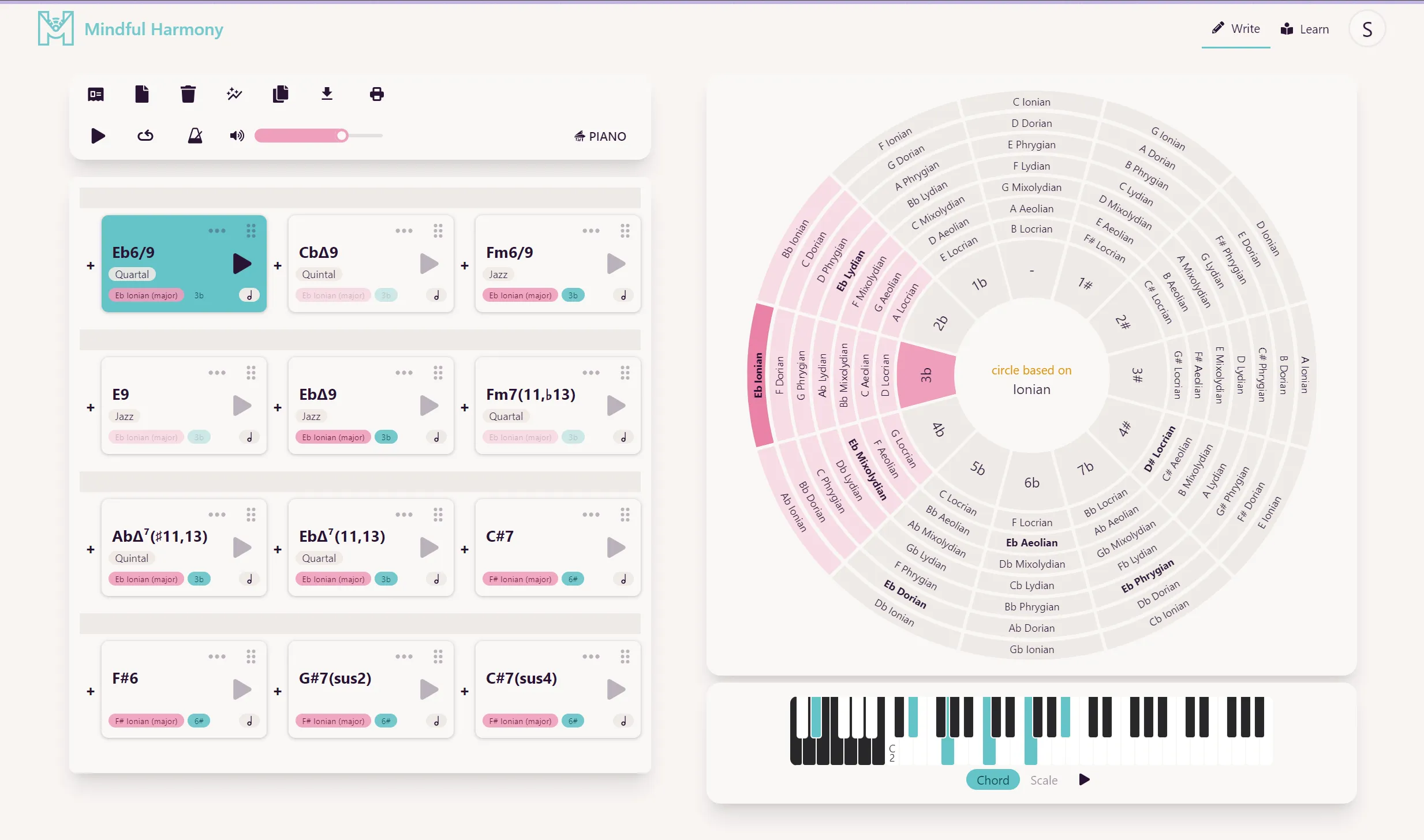
There are additional ways to tonicize chords, which we’ll cover in a future article. Experimenting with tonicization is easy in the Mindful Harmony chord progression app. If you haven’t already, start your free trial to discover how enjoyable it can be to enhance your songwriting skills.
Start writing beautiful harmony today!
Go To The AppNow, let’s move on from tonicization and explore Chromatic passing chords.
Chromatic Passing Chords
A chromatic passing chord is a diminished chord that sits a semitone above the chord it precedes. Similar to secondary leading-tone chords, chromatic passing chords create a stepwise movement in the progression. However, in contrast to secondary leading-tone chords, chromatic passing chords create a downward motion. Consider this example:
Chromatic Descending Passing Chord
iii
♭iii
ii
V
This technique offers an exciting way to embellish our chord progressions. Let’s move on to explore another method for enhancing our harmonic choices.
Modal Interchange
Modal interchange involves borrowing chords from a parallel mode of the scale we’re writing in. For example, if we’re composing in C major, we can borrow chords from C Aeolian (minor), C Mixolydian, C Lydian, or any other mode of the major scale. The parallel minor scale is the most common source for borrowed chords in major key compositions.
It’s unusual to borrow the tonic chord from another mode. Thus, when writing in C major, the available triadic chords we can borrow from C minor are Ddim, Eb, Fm, Gm, Ab, and Bb.
Let’s examine real-world examples to understand the sensations borrowed chords can provide. In “The Circle of Life,” which we analyzed earlier, there are multiple borrowed chords from the parallel minor scale.
In the verse, from 1:02, we find this sequence. The lyrics are: “There’s more to see than can ever be seen. More to do than can ever be done.”
There's more to see than can ever be seen..
vi
ii
♭VII
V
V
The bVII chord is borrowed from the parallel minor scale, Bb minor. How does it make you feel? For me, it creates a sense of awe and excitement. There’s another borrowed chord at the end of the chorus.
Till we find our place, on the path unwinding..
I
V/ii
ii
iv
I
We’re back at 1:58 where the lyrics are “Till we find our place, on the path unwinding”, and the borrowed chord iv appears on “unwinding”. What sensation does it give you? Personally, I get the sense that the chorus comes to an unexpected halt, as if we were on an epic flight and suddenly had to turn and prepare for landing.
The beginning of Flying by John Williams features a borrowed chord from the Lydian mode.
Note: by playing this video, you are accepting cookies from Google.
See Google's Privacy PolicyLydian modal interchange
I
I
II
V
The major II chord, borrowed from C Lydian, provides a sense of wonder.
The beginning of “The Night Window” by Thomas Newman features chords borrowed from the Phrygian mode.
Note: by playing this video, you are accepting cookies from Google.
See Google's Privacy PolicyPhrygian modal interchange chords
♭vii
I
iv
♭III
I
They evoke a sense of being torn between two emotions, like fear and safety.
Different borrowed chords create different emotions, and with Mindful Harmony, you can experiment with them all. For more examples of modal interchange, see our post “From Bland to Brilliant: How Modal Interchange Can Transform Your Music”.
From Bland to Brilliant: How Modal Interchange Can Transform Your Music
ReadChromatic Mediants
The final music theory concept we’ll explore in this article is chromatic mediants, a technique widely used in movie and game soundtracks. Earlier, we discussed mediants and submediants, both related to the tonic by a minor or major third. We can expand on this concept to create non-diatonic chords that fit beautifully into a major progression.
Recall that the mediant is a minor chord built a major third above the tonic. A chromatic mediant is formed by building a major chord from the same root note. In C major, this would be an E chord.
We can also construct major and minor chords a minor third above the tonic: Eb and Ebm.
Applying these ideas to the submediant yields the following chords: A, Ab, and Abm.
Try alternating between the tonic and one of the chromatic mediants. Go back and forth and see what sensations it creates.
Chromatic mediants in C Major
I
III
♭III
♭iii
VI
♭VI
♭vi
In “The Night Window” by Thomas Newman, which we mentioned earlier, the composer moves between the tonic D and its chromatic mediant Bb for dramatic effect. This can be heard from 1:25 in the piece.
Note: by playing this video, you are accepting cookies from Google.
See Google's Privacy PolicyChromatic mediant
I
I
♭VI
♭VI
♭VI
i
I
I
Conclusion
We’ve explored advanced harmonic concepts that can elevate your compositions: tonicization, chromatic passing chords, modal interchange, and chromatic mediants. Each technique offers unique ways to add color and sophistication to your chord progressions.
All these concepts are available for experimentation in the Music Theory app Mindful Harmony. Whether you’re a novice composer or an experienced musician, Mindful Harmony provides an intuitive platform to apply these techniques in real-time.
Start your free trial of Mindful Harmony today and transform your music-making process. Don’t just read about these concepts – experience them firsthand and take your songwriting to the next level.
Start writing beautiful harmony today!
Go To The App