
From Bland to Brilliant: How Modal Interchange Can Transform Your Music
Have you ever tried making a cool chord sequence using just the regular major scale, but it felt like something was missing? Well, that’s where Modal Interchange comes in. In this article, we’ll show you how many famous songs use this musical trick to grab your attention. We will also show you the easiest way to write chord progressions with modal interchange.
What is Modal Interchange?
Modal interchange, also called “borrowed chords” or “modal mixture”, is like mixing and matching different ingredients to create a unique and exciting dish. It’s a music theory concept that is all about combining chords from various musical “flavors” to make your songs more interesting.
Imagine you’re using the basic ingredients (chords) from one scale, like making a simple soup. Modal interchange lets you sneak in some special seasonings (chords) from other keys. These “spices” can change the mood of your chord progressions.
For example, if your song is generally happy, you can borrow a “spicy” chord from a sadder-sounding mode to add some depth and emotion.
Each musical “flavor” or mode brings its own unique chords, like different spices, and you get to decide how much to use. It’s a creative way to make your music stand out and tell a more exciting story.
This is how modal interchange works. Let’s say you are writing a chord progression in C major. The available triads in that scale are C, Dm, Em, F, G, Am, and Bdim. You might begin by writing a chord sequence with some of these chords. But with modal interchange, you can use chords from a related mode of C major, like C minor. The available chords in C minor are Cm, Ddim, Eb, Fm, Gm, Ab, and Bb. Since these chords come from a related scale to C major, they tend to feel like they fit.
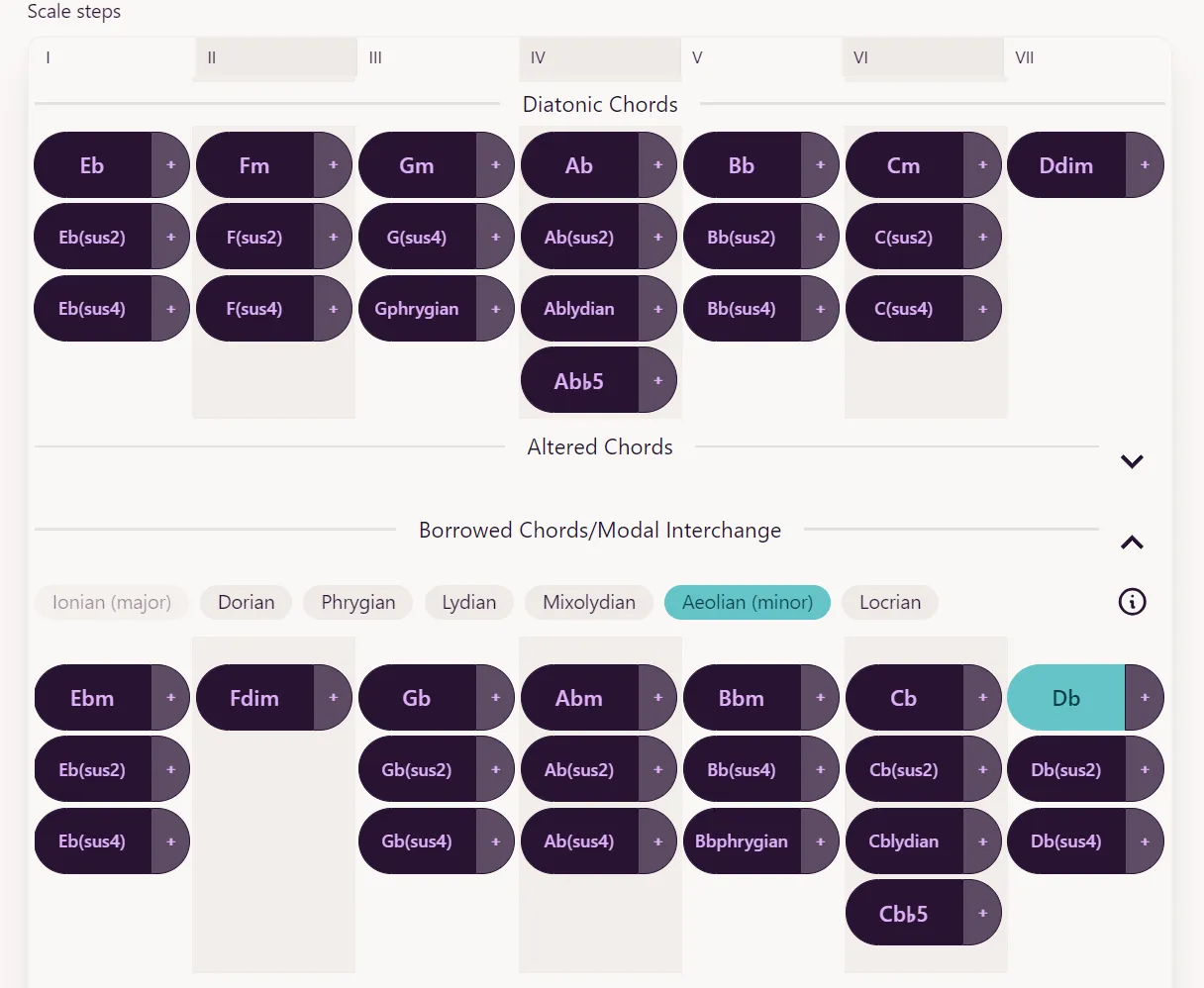
With Mindful Harmony, it is easy to find these modal interchange chords and to experiment with them.
Start writing beautiful harmony today!
Go To The AppBorrowing chords from the parallel minor
Here are a couple of songs that borrow chords from the parallel minor scale.
Beatles - Blackbird
Note: by playing this video, you are accepting cookies from Google.
See Google's Privacy PolicyOpen the progression and follow along.
Open SongThe song Blackbird by The Beatles is written in G major. But in this part of the song we find the Cm chord, which does not belong to G major since it has an Eb note in it. The Cm is being borrowed from the parallel minor scale, G minor. What emotions does this evoke in you?
The Beatles - Hey Jude
Note: by playing this video, you are accepting cookies from Google.
See Google's Privacy PolicyOpen the progression and follow along.
Open SongThe ending of Hey Jude by The Beatles is written in F major, but there is an Eb chord in the progression which is not to be found in the F major scale. It is being borrowed from the F minor scale. How does this borrowed chord taste to you?
John Williams - Jurassic Park Theme
Note: by playing this video, you are accepting cookies from Google.
See Google's Privacy PolicyOpen the progression and follow along.
Open SongThe joyful theme song from Jurassic Park is written in the Bb major scale. But in this section, there is a chord that spices things up. The Ab, borrowed from the Bb minor scale, feels fantastical, heroic, and slightly otherworldly.
The Easiest Way To Use Modal Interchange
With the music theory app Mindful Harmony, writing chord progressions with modal interchange is simple. These are the steps:
-
Add a chord by pressing the + button.
-
Select a scale from the circle of fifths.
-
Open up the Modal Interchange section.
-
Choose a scale that you want to borrow a chord from.
-
Listen to the chords and add the ones you want.
Start writing beautiful harmony today!
Go To The AppThis is easier than using a borrowed chords chart. It’s a fully interactive and creative experience.
Read more:
Open Music Theory