Quickstart Guide: Getting Started with Mindful Harmony
Note: by playing this video, you are accepting cookies from Google.
See Google's Privacy PolicyWelcome to Mindful Harmony’s Quickstart Guide! Whether you’re new to music or a seasoned musician, we’re here to help you get started with our Music Theory app. In this article, we’ll introduce you to the Circle of Fifths, adding chords, modes, and modulation. Let’s dive in and create beautiful music with Mindful Harmony!
Start writing beautiful harmony today!
Go To The AppWhen you launch the app, you’ll see the chord list on the left and the circle of fifths on the right. If you are using a smaller device, the circle of fifths is hidden within a dropdown menu.
The Circle of Fifths - An Introduction
As you might have guessed, the Circle of Fifths plays a central role in the Mindful Harmony app. It will truly empower your compositions and grant you fine-grained control over the emotions in your songs. How does it work?
The Circle of Fifths is a visual representation of musical scales, illustrating how they relate to each other. At the top, we have the C Major scale (also known as “C Ionian,” but more on that later). Moving clockwise to the next step on the circle, you’ll find the G Major scale.
How do these two scales relate to each other? Firstly, there is a fifth interval between the root notes of these scales, C and G. Secondly, C Major has no sharps or flats, meaning it consists entirely of white keys, while G Major has one sharp. In summary, when comparing the first scale in the Circle of Fifths, C Major, to the second scale, G Major, the second scale is a fifth away and contains one more sharp note.
The C Major Scale is all white keys
The G Major Scale has one sharp
This pattern continues as you proceed clockwise around the Circle of Fifths. Each clockwise step adds a sharp note to the scale. C Major has 0 sharps, G Major has 1 sharp, D Major has 2 sharps, A Major has 3 sharps, and so on.
Now, let’s return to the top of the circle, to C Major. This time, we’ll move counter-clockwise, arriving at F Major. F Major is, as you’ve guessed, a fifth away from C but in the opposite direction. When moving counter-clockwise, we don’t add sharps; instead, we add flats. Therefore, F Major has one flat, Bb Major has 2 flats, Eb Major has 3 flats, and so on.
The F Major Scale has one flat
Now that you understand why the scales are arranged this way in the Circle of Fifths, you might be wondering how this knowledge can help you gain more control over the emotions in your songs. We’ll get back to that in a minute. But first, let’s add our first chord to your song.
Adding Your First Chord
Let’s begin by pressing the “+” button in the chord list to add a chord. Now, it’s time to choose the scale on which to base our chord progression. Let’s select C Major from the top of the Circle of Fifths.
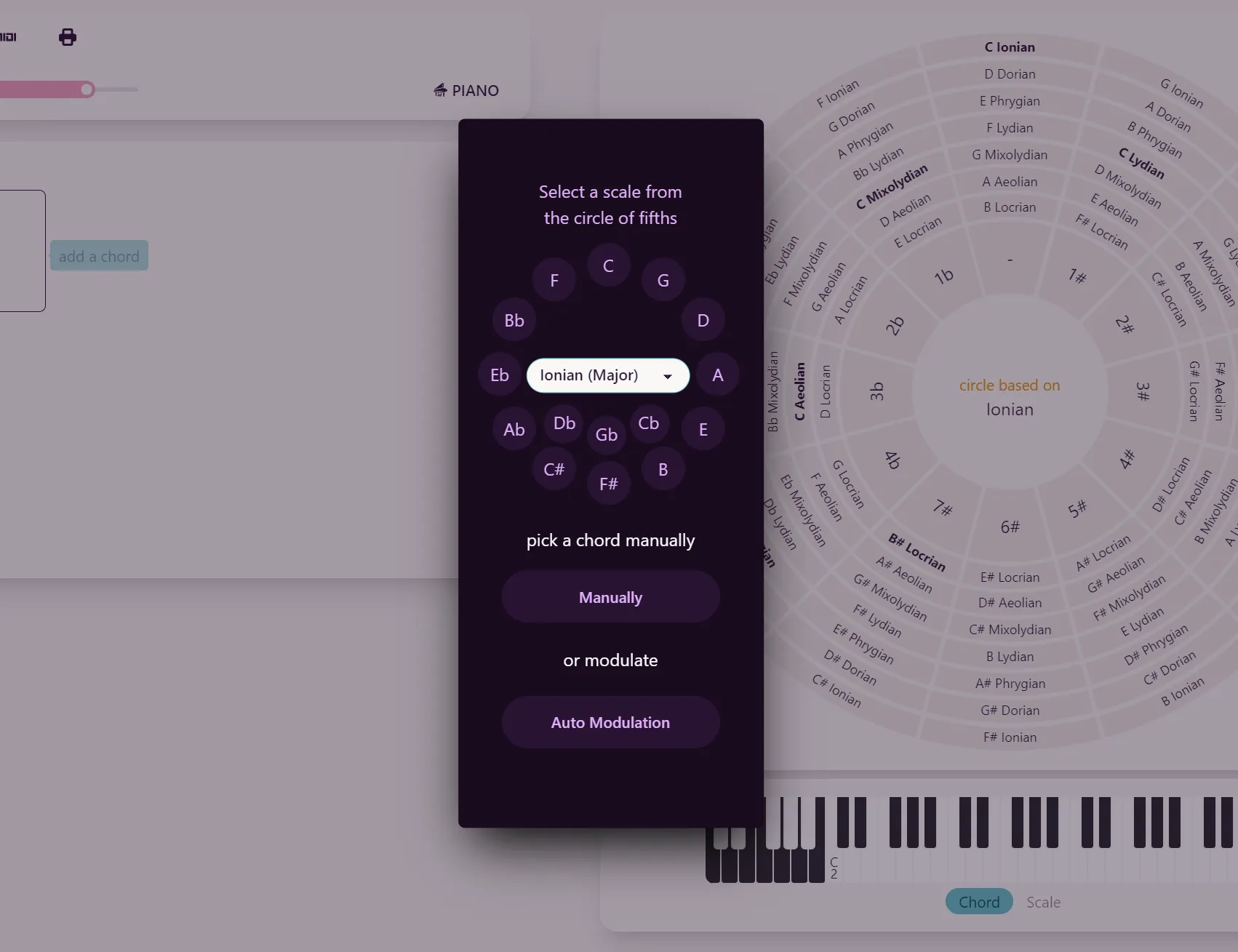 You will now see the chords that are diatonic to the C Major scale, meaning all their notes can be found in the C Major scale. These chords are arranged sequentially with corresponding roman numerals (I to VII), representing each step of the scale.
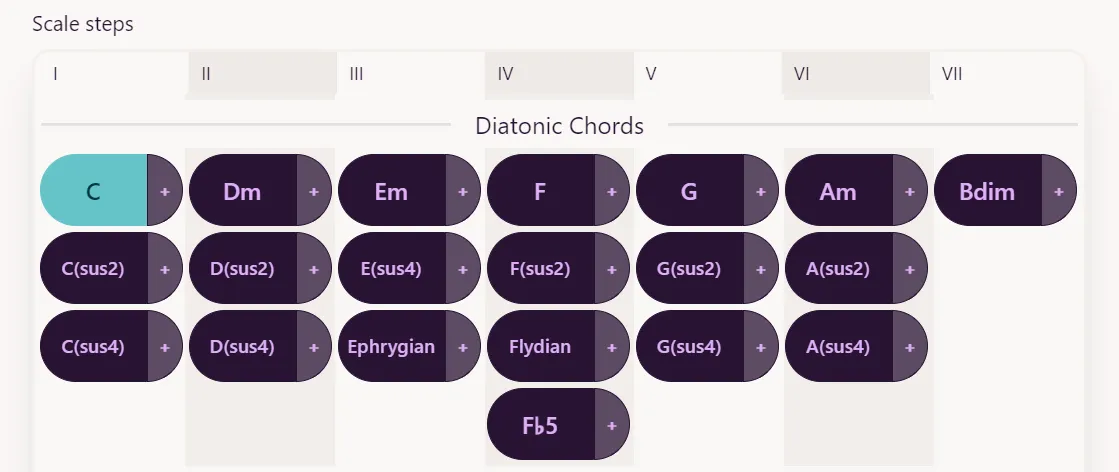 You can audition the chords by clicking on them, and when you’re ready to add a chord to your song, simply click the small “+” button next to the chord. If you’re using a smaller device, you won’t see the “+” button; instead, an “add chord to song” button will appear.
Congratulations! You’ve successfully added your first chord to your song.
The Chord Selector in Mindful Harmony offers a range of features that can assist you in crafting wonderful chord progressions. While we won’t delve into further details in this article, please feel free to explore and experiment. Now, let’s return to the Circle of Fifths for a moment.
Hover over the chord in the chord list and take a look at the Circle of Fifths on the right side, or in the curtain menu if you’re using a smaller device. You will notice the circle lighting up in certain places. It illuminates every scale on the circle where the selected chord can be found and also highlights the scale from which the chord was chosen.
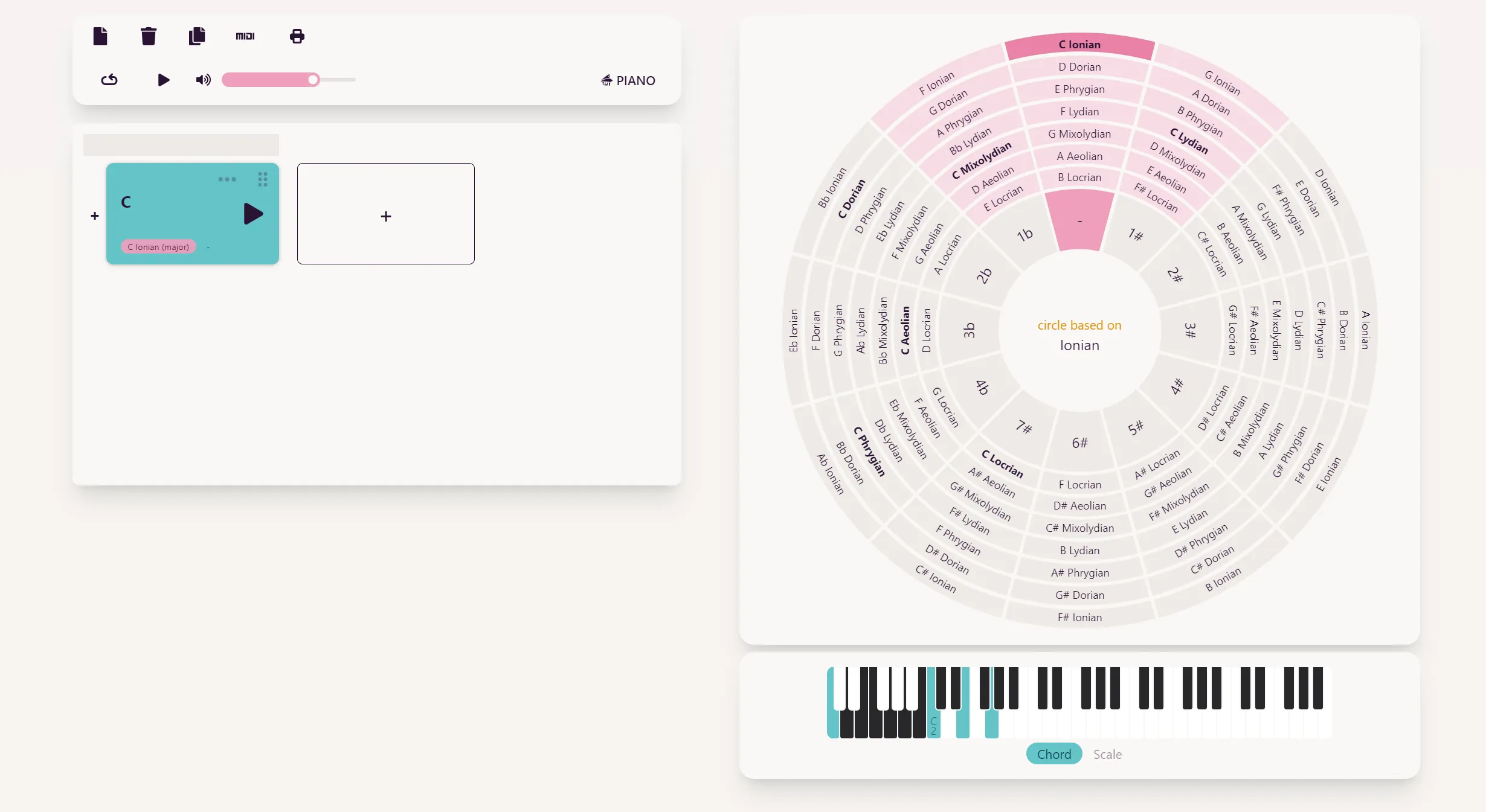
Note: If the chord is non-diatonic, the scale from which it was selected will be outlined. More information on non-diatonic chords will be covered in another article.
Modes
What about the minor scale? How does it fit into the concept of the Circle of Fifths? The minor scale is, in fact, a mode of the major scale known as “Aeolian.”
Let’s use the C major scale as an example. It comprises the notes C, D, E, F, G, A, and B, all of which are the white keys on the piano. If we were to play these notes in the same order but start and end on A instead of C, we would be playing the A minor scale. The A minor (or A Aeolian) scale is considered a mode of the C major scale because they share the same notes.
The C Major (Ionian) Scale
The A Minor (Aeolian) Scale
The same principle applies to D Dorian, E Phrygian, F Lydian, G Mixolydian, and B Locrian. They all consist of the same notes but begin and end on different notes. Each of these scales is considered a mode of C major.
Therefore, all these scales are positioned within the same step of the Circle of Fifths.
The emotions of the seven modes
Each mode has its own feeling due to the different intervals between the notes. How they are perceived is probably a bit subjective, and the context also plays a role, but nonetheless, here is a broad description of how the seven modes of the major scale feel.
Ionian (Major) has very little tension in it. It often has a positive vibe to it. It’s pleasant, airy, and predictable.
The C Ionian Scale
Dorian is similar to the minor (Aeolian) scale, but it has another side to it. It has a brightness to it that other minor scales don’t. And that can give it a sense of melancholy.
The C Dorian Scale
Phrygian is another minor scale, which starts with a minor second interval, bringing more tension to the table and a sense of seriousness and darkness.
The C Phrygian Scale
Lydian is a major scale with a raised fourth. This gives the scale a very dreamy and adventurous vibe. There is very little tension in the Lydian mode. This scale can be commonly heard in film music.
The C Lydian Scale
Mixolydian is a major scale with a flat seventh, which is why it is commonly referred to as a dominant scale. It’s full of character and is often associated with jazz music.
The C Mixolydian Scale
Aeolian (Minor) is the natural minor scale. It’s probably the most commonly used scale after the major scale. It can bring a sense of sadness or beauty.
The C Aeolian Scale
Locrian is a scale that lacks a perfect fifth. This makes it quite hard to use and therefore it’s not a common scale to hear. It’s quite unsettling and otherworldly.
The C Locrian Scale
Tip: Listen to the chords from the parallel modes of C major. By “parallel,” we mean scales that both start and end with C. These include C Dorian, C Phrygian, C Lydian, C Mixolydian, C Aeolian, and C Locrian. See if you can locate these scales in Mindful Harmony. You can easily find these chords under “Borrowed Chords” in the chord selector. This will provide you with a good understanding of the emotional qualities of the modes.
Start writing beautiful harmony today!
Go To The AppModulation
What is musical modulation? Modulation has been defined as a change of key that happens within a composition. The music has modulated to a new key when the listener no longer hears the original tonic as “tonic” anymore. (The tonic is the first chord of the scale or the tonal center of a part of a song.) When that happens might be subjective. As composers, we want to guide our listeners’ ears so that they perceive the harmony that we want them to hear.
In popular music, a common use case is to make a “key change” at some point in the song to achieve a rise in energy. A more subtle use of modulation is nowadays commonly heard in film music and jazz. But in all kinds of music, modulation is an amazing opportunity to create depth and evoke emotions. Why limit your musical palette to just one key?
Modulating With The Circle of Fifths
The circle of fifths is a great tool for knowing what keys to modulate between. There are two things to take into consideration when choosing what keys to use. The first one is the direction in the circle of fifths, and the second one is the distance within the circle of fifths.
The direction
When modulating clockwise around the circle of fifths, the music can feel like it “lifts”. This is due to the sharps added to/flats removed from the key. On the other hand, when modulating counter-clockwise around the circle of fifths, the music can feel like it becomes darker or resolves. This is due to the sharps removed from/flats added to the key.
The distance
The distance between the two keys we are modulating to and from has an impact on the effect of the modulation. The closer the distance between the keys of the modulation, the subtler the sensation. For a more dramatic effect, we may choose a destination key further away in the circle than the start key.
There are two main ways to introduce a new key. There is the direct way and the subtle way. We will cover both of them briefly.
Direct Modulations
A direct modulation goes abruptly to a new key. Our ears usually need time to adjust to a new key. It is however possible to start playing in a new key without a long and well-planned cadence. And sometimes that might be just what you are after. One way to go about it is to make the modulation at a phrase boundary, in a logical place melodically and rhythmically.
When composing modal music, which is music centered around a specific mode, it’s often typical to use a direct modulation if you want to switch to a different key
Pivot Chord Modulations
One common way to achieve a subtle modulation is by using a pivot chord. A pivot chord is a chord that can be found in both the home key and the destination key.
In Mindful Harmony, you can utilize the Auto Modulation feature to discover pivot chords for nearly any modulation between Major (Ionian) and Minor (Aeolian) scales.
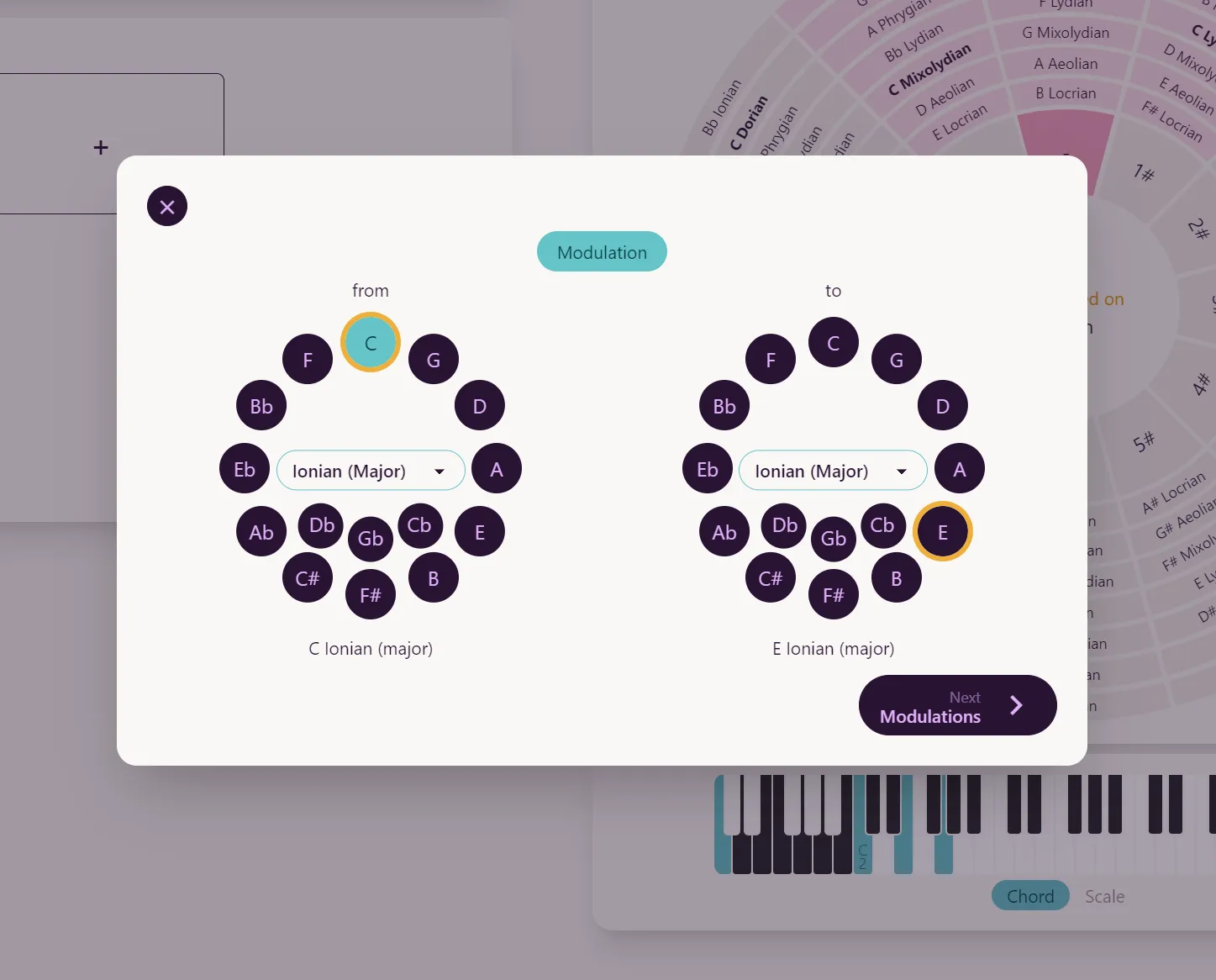 To do this, follow these steps:
- Press the “+” button in the chord list where you want to introduce the modulation.
- Click on Auto Modulation.
- Choose a starting scale and a destination scale.
- The Auto Modulation algorithm will identify potential pivot chords for you.
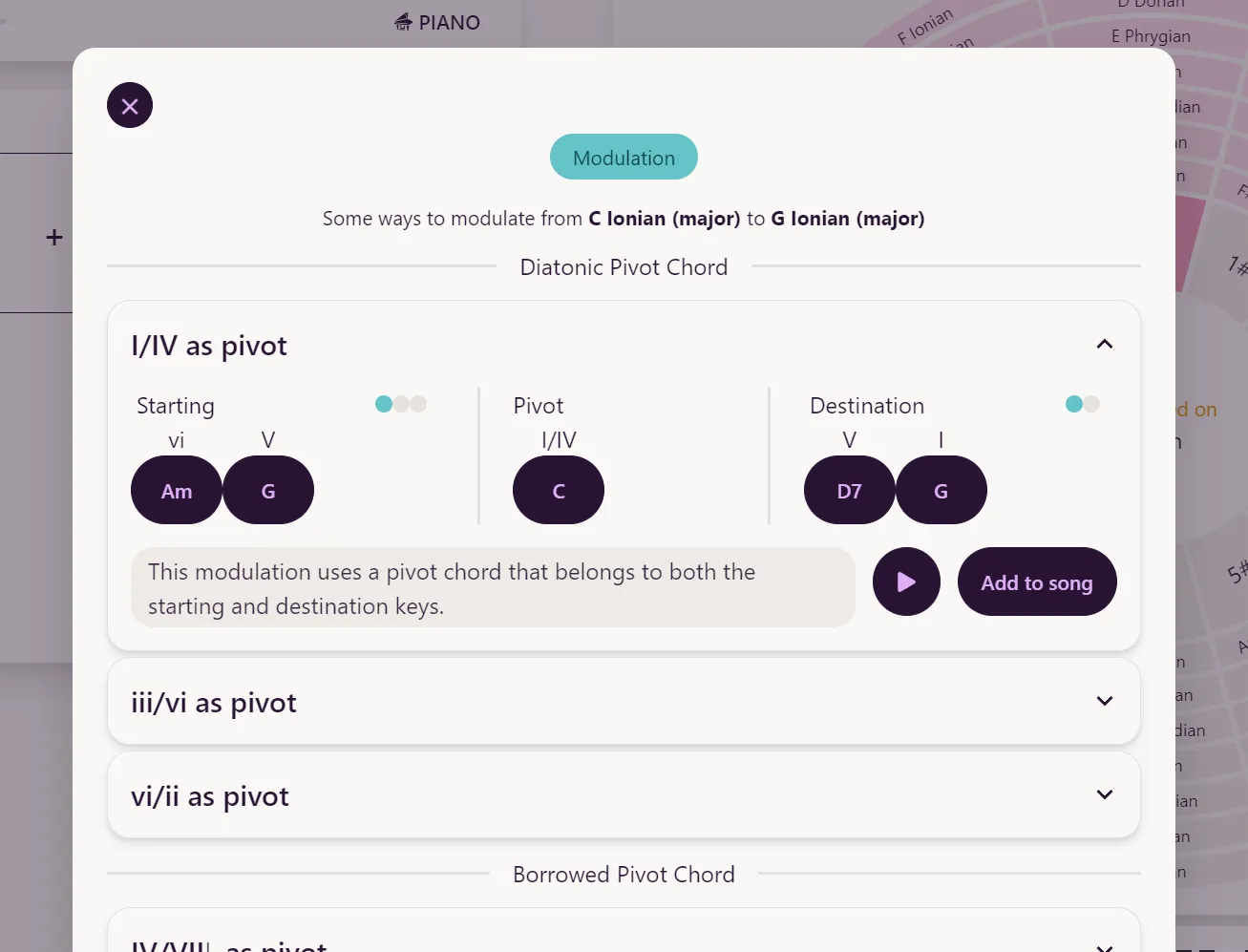 You can audition them, make adjustments to the starting and destination chords as needed, and then add the chord progression to your song.
This tool is super useful when you wish to create a modulation. But remember, the chord progressions it suggests are just starting points. You can always edit them, remove any parts you don’t like, and make them fit your style perfectly.
In Conclusion
In conclusion, Mindful Harmony can assist you in effortlessly creating beautiful chord progressions. We encourage you to explore these tools to expand your musical skills and compose remarkable pieces. It’s important to note that there is much more to Mindful Harmony than what we’ve covered in this article. If you subscribe to our newsletter, you’ll receive updates when we add new content to this Learn section.
Start writing beautiful harmony today!
Go To The App