5 Beautiful Ways To Voice A CΔ9 Chord
Have you ever played your favorite chords, enjoying them, but at the same time, wishing there was something you could do to breathe new life into them? Or have you ever listened to great piano players and wondered how they come up with the professional-sounding chords they play? The answer might lie in the way we voice the chords we play. What does that mean?
Let’s look at the CΔ9 chord as an example. The standard way to play it would look something like this:
CΔ9, standard voicing
What we have here is a stack of third intervals. It’s the C major chord in root position, followed by a major seventh and a ninth. It sounds lovely, but we can do a lot more with it to give it some personality. We can “voice” the chord in different ways, which means moving around the individual notes, or “voices”, into different octaves, or even omitting some of the less important notes.
Jazz Piano Voicings
Jazz piano players use all sorts of voicings. We’ll take a look at some of the ways that a Jazz pianist might voice chords. But before we continue, here are a couple of key takeaways when it comes to what notes we play. In chords with a sixth or seventh, the two most characteristic and important notes are the third (or the sus2/sus4 in sus chords) and the sixth/seventh. If you play them while a bass player is playing the root, your audience will feel the movement of the song. The other notes, such as the fifth, can be seen as embellishments or color tones.
One-handed, Condensed, Jazz Voicings
If you’ve only got one hand free to play a chord, here are two formulas for you. Let’s call them Type A and Type B. In Type A, the third is at the bottom, and in Type B, the sixth or seventh is at the bottom.
The color tones can be any other notes than the third or sixth/seventh, such as the ninth, eleventh, thirteenth, root, or fifth.
Type A
3 - [color tone(s)] - 7 - [color tone(s)]
CΔ9, Condensed Type A Jazz voicing
Type B
7 - [color tone(s)] - 3 - [color tone(s)]
CΔ9, Condensed Type B Jazz voicing
In these examples, we are using the color tones 5 and 9.
Tip: Try dropping the second or third note from the top of the chord down an octave. This is sometimes called a drop-2 or drop-3 modification, and it’s a way to spread out the voicing.
Two-handed, Spread, Jazz Voicings
If you want to play wider chords with two hands, try these two ways. This time, we will play the third and the seventh in the left hand, and the color tones in the right hand. We will be using the same terminology as before, where Type A means that the third is at the bottom, and Type B means that the sixth/seventh is at the bottom.
Type A
3-7-[color tones]
CΔ9, Spread Type A Jazz voicing
Type B
7-3-[color tones]
CΔ9, Spread Type B Jazz voicing
Again, we are using the fifth and the ninth as color tones.
Let’s move on to another very exciting type of voicing, the quartal voicing.
Quartal Voicings
Quartal voicings can sound modern, ambiguous, and sophisticated. The idea is to form a chord where the majority of intervals are fourths. If we omit the root, we can form a quartal voicing with our CΔ9 chord.
CΔ9, Quartal voicing
This chord has two perfect fourth intervals and a third interval in the middle. With some chords, it’s possible to have every interval be a fourth. Let’s try swapping out the major seventh note for a sixth note, creating a C6/9 chord. That chord can be voiced with only perfect fourth intervals, like this.
C6/9, Quartal voicing
Let’s move on to another exciting voicing type: Quintal voicings.
Quintal Voicings
Quintal voicings are voicings where the majority of intervals are fifths. They have a very open sound. Try to play this voicing of the CΔ9 chord.
CΔ9, Quintal voicing
As you can see, this voicing has three perfect fifth intervals and one major second interval. As with quartal voicings, not every chord can be constructed using fifth intervals exclusively, but throwing in a narrow, more dissonant interval somewhere in the voicing can sound very beautiful.
Talking about dissonance, let’s move on to our last voicing type: Cluster voicings.
Cluster Voicings
With cluster voicings, the idea is to group a collection of short and dissonant intervals into a cluster and place them somewhere in the voicing. Our first example has the cluster in the middle and one larger interval on each side of the cluster.
CΔ9, Cluster in the middle
Dissonant intervals tend to sound less dissonant in higher registers. Here is a cluster voicing of the same chord, but with the cluster at the top.
CΔ9, Cluster at the top
With some chords, it is possible to place every note into one single cluster. Let’s add an eleventh to our CΔ9 chord and construct a fully clustered voicing.
CΔ11, Fully clustered
Artistic Freedom
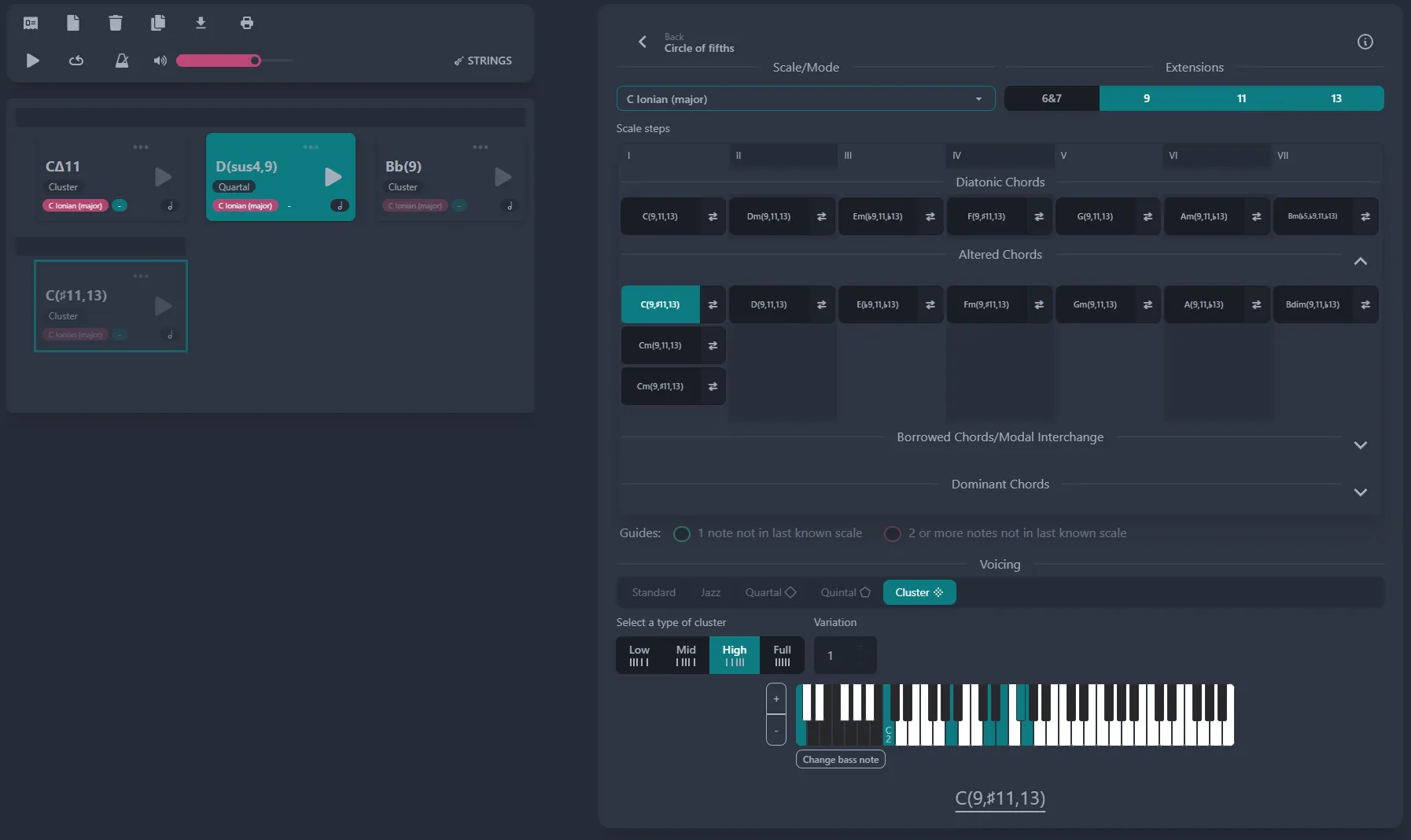
Why not incorporate these chord voicings into your practice routine? Getting them under your fingers will surely elevate your playing and provide you with more ways to express yourself. All of these voicings, along with even more options, are available in Mindful Harmony, the theory-oriented chord progression app. Start your free trial and begin using these beautiful voicings in your songs today!
Start writing beautiful harmony today!
Go To The App